



Description
Matiwane’s amaNgwane
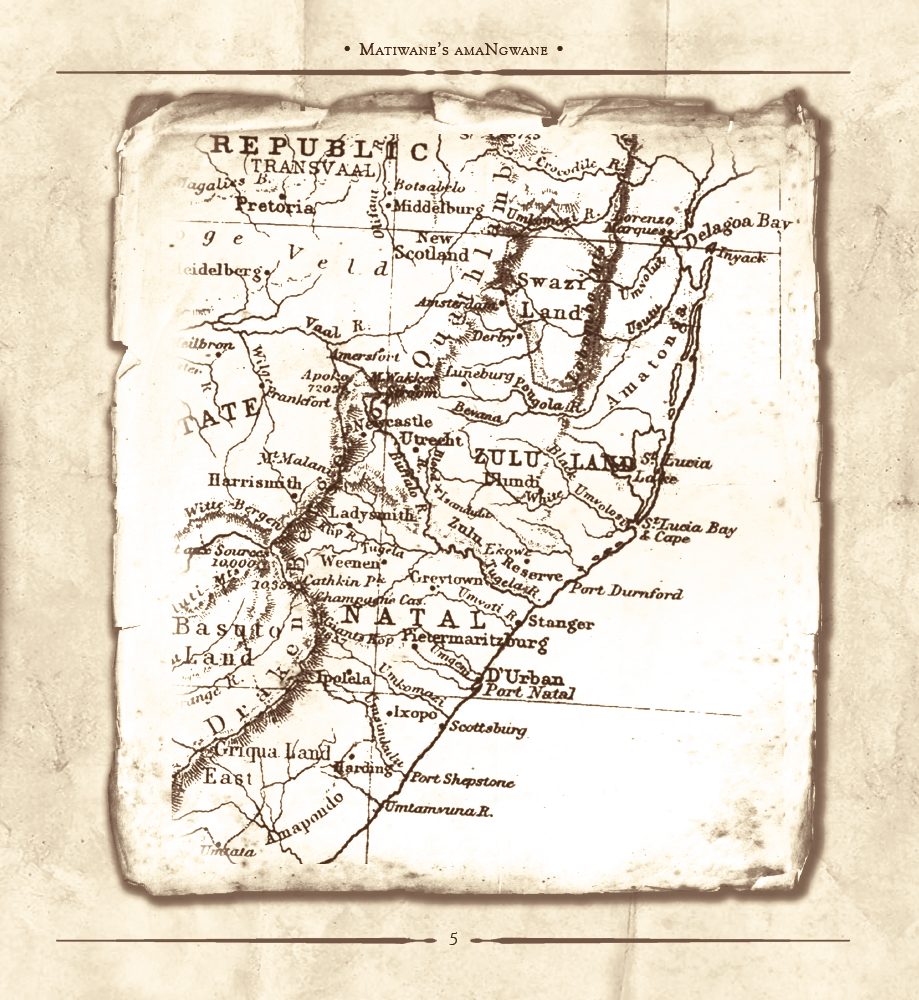
This title is an abridgement of a larger volume and retells, in an easily accessible manner, the story of Matiwane, as told by his grandson Msebenzi to his kinsman Rev. Albert Hlongwane. It tells of his flight from KZN through present day Lesotho, Free State, and Eastern Cape culminating in the Battle of Mbolompo in 1828. Rev. Hlongwane is buried in a cemetery near the mission in which he worked, in the small village of Hoffenthal, not far from Bergville in KZN.
Matiwane’s ancestors
The storyteller sat on an old gnarled tree stump of an acacia tree, under the warm afternoon sun, surrounded by children waiting for a story. The first fruits festival was drawing to a close. He could hear the heads of the tribe’s cattle bellowing and it brought back the sounds of battle, of tribes fighting for power and territory. As he began his story about one of the most feared and repected chieftains, more children joined them. They were happy to sit in the sun and rest a while after such a thrilling day. He waited for them to get comfortable then, as a hush descended, he started his tale. Just hearing the chieftain’s name sent a shiver down his spine.
‘Matiwane” he uttered, his voice no louder than a whisper.

‘He chose to live by stealing from and looting clans in raids. He would burn their fields, homes and cattle kraals to the ground, ruthlessly destroying everything in his path and showing no mercy as he did so. This type of warfare is called ‘scorched earth’ because you leave behind land that is useless to grow crops, useless to feed animals, useless for anyone to live on. It is a brutal, but very effective tactic of war. No one was safe from him until one day when…. Wait, I am getting ahead of myself. Let me start at the very beginning. I still wonder how this short, stout, almost unimpressive looking man, who normally wore a cloak of black-and-white calf skin, could create such fear in others. Matiwane’s native tongue was isiZulu, like that of Shaka and Dingane. They, however, were great warriors, as they towered over their people and gained respect by showing bravery and imagination with battle tactics. On the other hand, Matiwane…’
Let’s take a look at Matiwane’s family line first to discover how he learnt to be so cunning and so utterly ruthless. We do not need to travel too far back though. We can start with Tshani, Matiwane’s grandfather. Tshani had no sons until one day his sister-in-law, who was staying with his great wife, came to visit. The story goes that the great wife sent her sister to Tshani to have a son. This was done secretly so that no one else would know about it.
Just a short time afterwards, the girl told Tshani’s mother, a respected woman of the clan, ’Great mother, see this that has happened to me…’. She was referring to the fact that she was pregnant. Two things then happened: Firstly, Tshani’s mother confirmed that Tshani was indeed the father of the unborn child. Secondly, but no less importantly, she swore the girl to silence, and told her never to speak about who the father was.
Tshani’s mother then sent the girl back to her parents. When she heard that a boy had been born, Tshani’s mother would often send a goat to make sure that both the mother and the child were kept healthy. As the boy matured and reached puberty, and was about to change from a child to an adult, she sent a few ‘spoonholders’ of the inkosi to look after the boy. The ‘spoonholder’ has an honoured position within the clan. This was because it was their responsibility to hold the spoon of the royal inkosi, or member of the royal family, to make sure that they ate well, stayed healthy and became strong as they grew into adulthood.


